Problem Formulation
Basic elements of simulation-based engineering design optimization utilizing NNs as surrogate models are depicted in Fig. 3. It illustrates both one-shot and sequential sampling, which follow the same initial steps up to the construction of NNs. It begins with generating a design population, followed by physics-based simulations that evaluate corresponding outputs to form training data for the NNs. With this data, optimal HPs are determined to construct the NNs. These NNs replace the physics-based simulation to identify optimized designs in the one-shot method and discover new sample points based on the infill criterion in the sequential sampling. If a stopping condition is not reached, these new samples are integrated into the training dataset for future iterations.
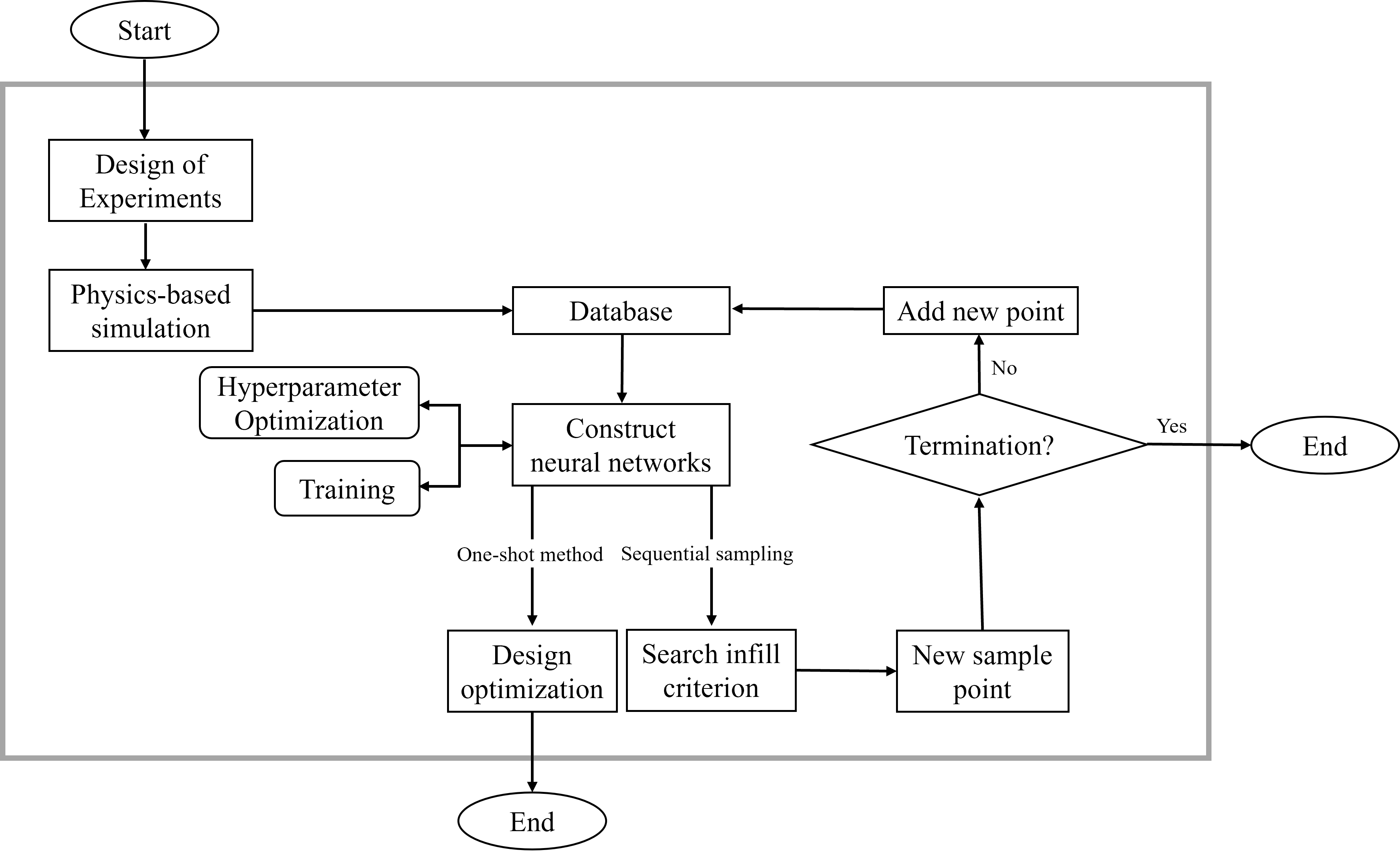
Figure 3 : Flowchart of simulation-based engineering design optimization with neural networks for the one-shot method and sequential sampling.